Managing Technology and Transforming the Business Are Not the Same Thing
Written by Evren BalPublished · 5 min read

💡 Key takeaways
- IT operations and digital transformation produce different business outcomes. One keeps today's systems running; the other changes how the company works tomorrow.
- Technically similar systems can have very different business value. Employee access to an ERP system and a customer-facing digital platform may rely on similar infrastructure, but one supports internal productivity while the other directly affects revenue and customer experience.
- The CIO–CTO distinction is more than a title debate. Separate roles reflect the fact that continuity and competitive advantage require different management focus.
When a business owner thinks that “everything related to technology is IT's job,” they are probably seeing technology only as an infrastructure function.
But the term “IT” now collects very different kinds of work under one umbrella.
An employee's mouse may not work. They may not be able to access email, connect to the ERP system, use the office network, or get on the VPN. Antivirus licences need renewing; access must be managed; backups have to run; systems need to stay secure.
All of this is technology work. But so are these things:
- Using data to determine which customer the sales team should approach with which offer
- Analysing customer requests with AI and routing them to the right team and action
- Measuring which marketing channels actually create revenue and reallocating budget dynamically
- Predicting a manufacturing problem before it occurs
- Automating hundreds of manual operations and moving routine work from people to systems
- Creating a new digital channel that changes the customer experience
- Turning company data into a new product, service, or revenue model
Yet in many companies, both needs still receive the same response: “Let's talk to IT.”
Keeping today's systems running and changing how the company works may sit under the same technology heading, but they are not the same responsibility.
The same technology, two different responsibilities
There are really two different jobs being described here.
The first is keeping the technology the company already uses running reliably. Employees need to use their computers, access the ERP, send email, stay connected to the network, work securely, and know that backups are being taken.
The success of this function is usually measured through:
- Continuity
- Security
- Standardisation
- Service quality
- Cost control
The second responsibility is using technology to change the way the company works.
The question is no longer “Is the system working?” Instead, the questions become:
How can we increase sales?
Can we automate this process completely?
Can we understand our customers better?
Can we make this manageable by two people instead of ten?
What capability can technology give us that our competitors do not have?
This second area goes beyond operational continuity. It directly touches the business model, customer experience, efficiency, revenue growth, and competitive advantage.
For example, a system that automatically routes sales enquiries based on rules, capacity, and customer context is not merely a software project. It changes how the company makes decisions. I wrote about one concrete example in how we built a real-time decision support and sales management platform at Vanity.
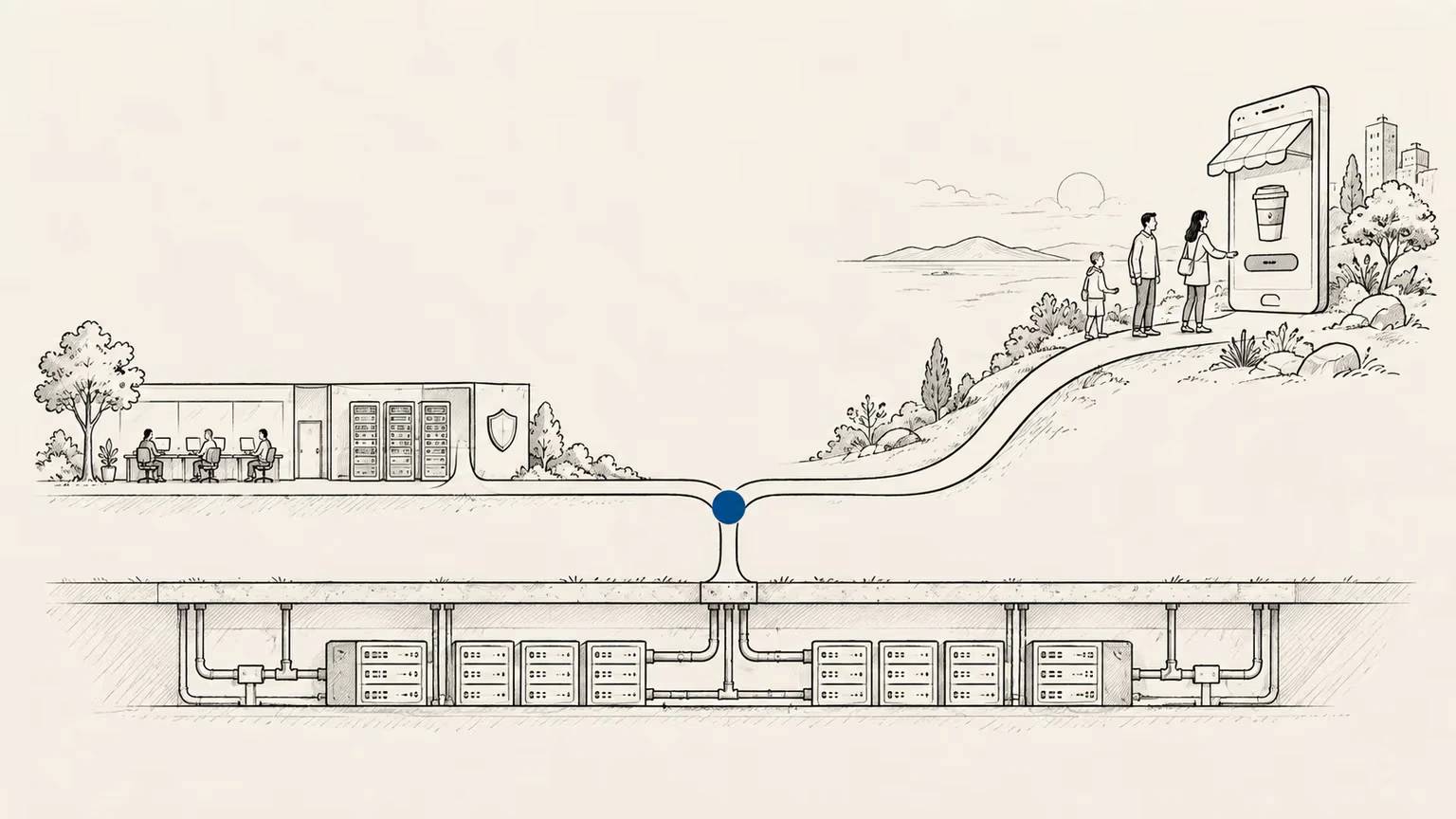
Even infrastructure can have different business impact
The distinction appears at the infrastructure level as well.
A server that gives employees access to an ERP system and a server that keeps a customer-facing digital platform online may look technically similar. Both need performance, availability, security, and redundancy.
But they do not play the same role in the business.
The first allows employees to do their jobs. The second reaches customers, generates revenue, enables growth, and in some companies is the product itself.
So the issue is not simply renaming the IT department. The real issue is understanding what role technology plays inside the company.
On one side, there is this need:
Keep the company running.
On the other:
Help the company work better, faster, and differently.
What the CIO–CTO distinction tells us
One management-level reflection of this difference can be seen in the CIO and CTO roles.
Traditionally, a CIO is closer to internal systems, enterprise applications, information security, infrastructure, and the technology employees use. A CTO sits closer to the part where technology becomes product, customer value, and competitive advantage.
Of course, these titles mean different things in different companies. In some organisations, the CIO also owns digital transformation. In others, the CTO leads the whole technology organisation. Elsewhere, CTO mostly means the leader of a software development team.
Still, the fact that CIO and CTO emerged as distinct roles points to an important need: managing the technology a company uses is not the same as using technology to shape the company's future.
AI makes that distinction even clearer. It is not only a tool that speeds up existing work slightly; it can create new capacity for review, classification, and decision-making that would not previously have been economically feasible. But once that capacity becomes critical to operations, the company also needs to manage its AI dependency and operational resilience.
The resulting speed still needs good judgment and verification. I explored that trade-off in AI made code cheap, but verification is still expensive.
Day-to-day operational needs are usually urgent. When the same team, and often the same leader, is expected to carry both responsibilities, they can crowd out transformation work and leave its ownership unclear.
In my view, the deeper mistake starts before the organisation chart: do we see technology only as a support function that keeps the company running, or as a strategic capability that can transform how the company competes?
If this article was useful
Linking to it from a relevant page on your website or sharing it on social media genuinely helps it reach more people. Thank you for your support.
Linking and brand guidelines →
A small experiment
Loading personal metrics…