How Should You Route Requests Across Multiple AI Models?
Written by Evren BalPublished · 9 min read

💡 TL;DR: Key Takeaways
- Using several models does not automatically justify an intelligent routing system. If language, document type, risk, or data policy determines the choice, start with an explicit rule.
- Model routing adds another prediction to the system. A router can choose the wrong model even when every model works correctly on the tasks it was designed to handle.
- A router should beat both the best single model and simple routing rules on the real workload. The comparison must include evaluation, latency, monitoring, and error-correction costs—not just model prices.
Imagine that your system uses two AI models. A smaller model handles frequent requests that are easy to classify at a lower cost. A more capable model is reserved for contract exceptions, ambiguous customer messages, and questions that require deeper reasoning.
This article does not ask whether the second model should exist. I addressed when one model is enough and what a second model must prove before it enters the system in the previous article. Here, both models already perform a measurable job and have earned their place.
The system must now decide which request goes to which model.
If a customer selects “delivery problem” on a form, the choice may be obvious. Software can send the request to the relevant model. The problem becomes harder when the customer writes freely and mixes several issues in one message. The system must then predict which model is likely to produce the better answer before either model has answered.
The layer that inspects a request and chooses a model is commonly called a model router. The process is known as model routing.
That label, however, covers several different decisions.
First decide what kind of routing you need
Sending a request to another model is not always an “intelligent” decision. Sometimes the destination is known before any model runs. Sometimes the system needs to inspect the first model's output. In other cases, the second model exists only to handle a technical failure.
| Method | When is the decision made? | Simple example | Operational cost |
|---|---|---|---|
| Explicit rule | Before a model call | Send a scanned invoice to a vision model and a text file to a language model | Keep rules and exceptions current |
| Predictive routing | Before a model call | Estimate request difficulty and choose the smaller or more capable model | Router errors, separate evaluation, and monitoring |
| Cascade | After inspecting the first result | Ask the stronger model to try again when the smaller model is not good enough | Another call, more cost, and more latency |
| Fallback | After a technical error or outage | Switch providers when the primary model does not respond | Continually verify that both options can perform the same job |
Products do not always use these terms in the same way. In its 2026 preview, Google Cloud's API Gateway model routing maps a model name in the request to a predefined destination. It does not decide which model would produce the better answer. It sends the requested name to the configured target.
Amazon Bedrock's intelligent prompt routing, by contrast, examines the request and predicts which of two models is more likely to perform well. The word “routing” describes an explicit traffic rule in one product and a new prediction in the other.
Define the decision before choosing the tool.

Do not predict a decision you already know
An insurer may send scanned claim documents to a vision model and call-centre recordings to a speech model. If the input format already determines the model, there is no reason to train another router.
Some requests must also stay inside a company-controlled environment because of data policy. High-risk transactions may never be eligible for the cheaper model. These constraints apply before a router makes any quality prediction.
An explicit rule is not chosen because it is less sophisticated. It is chosen because the decision is already clear. The team can see why a request went to a particular model and can test what changes when the rule changes.
This requires a distinction between what a model can do and what the system permits it to do. A model may be technically capable of processing sensitive data. If policy prohibits sending that data to its provider or region, the router should never include that model among the candidates.
AWS similarly explains that with geographic cross-Region inference, requests may leave the source Region and, in some circumstances, may be stored in the destination Region for abuse detection. A routing policy cannot consider quality and price alone. It must also respect where data is allowed to go.
When does an intelligent router earn its place?
Explicit rules are not always enough. A customer support channel may receive straightforward address changes alongside disputes involving several contract clauses. Both requests are text. They may be written in the same language. Yet they do not require the same model capability.
In this kind of workload, a router predicts which model is better suited to each request. If the smaller model handles easy requests at an acceptable quality level, costs may fall. Sending harder requests to the stronger model may preserve quality.
The RouteLLM researchers reported that routers trained on human preference data could preserve response quality while cutting costs by more than half on some benchmarks. This shows that routing can work. It does not show what happens in a company's live customer traffic, how long employees spend correcting mistakes, or whether the business outcome improves.
The models in front of the router must also complement one another. Putting three models with similar strengths and weaknesses into a pool does not make selection more valuable. If most traffic must reach the stronger model anyway, the router may add a new delay without producing meaningful savings.
An intelligent router therefore needs at least three conditions:
- The models perform measurably better on different parts of the real workload.
- Request volume is high enough to justify the cost of building and operating the routing layer.
- You can identify a misrouted request and measure its effect on the business result.
If any of these is missing, one model or a few explicit rules may be the better starting point.
More models do not automatically make the router better
The LLMRouterBench study found that some current routing methods did not produce an overall result that exceeded the result of the single model that performed best overall. Preserving quality while reducing cost was also difficult. A larger pool of models did not automatically produce a better result.
The study used benchmark datasets rather than a live customer support system. Even so, it establishes an important boundary: using a router does not mean you have selected the right model. The router is itself a model or decision system whose value must be demonstrated.
A managed service does not remove that responsibility. Amazon states that its intelligent prompt routing is optimized for English prompts and cannot adapt its choices to a company's own performance data. Microsoft likewise recommends, in its model router evaluation guide, comparing the router with direct model use on a sample that represents the company's actual requests.
A wrong route is a separate kind of failure
If the router sends a difficult request to the smaller model, the model service may operate exactly as designed. The answer can still be inadequate for the job. Worse, it may look plausible enough that the system never reports a technical error.
A fallback path does not solve this problem. Fallback usually begins when the first model fails to respond, hits a quota limit, or its provider has an outage. If the first model returns a fast but incorrect answer, the system does not see a technical failure and will not switch models.
A cascade takes a different approach. The system runs the smaller model first and then decides whether to accept its answer. An inadequate result is sent to the stronger model. Some requests will therefore incur two model calls, another evaluation step, and a longer wait.
Whichever method you choose, measuring each model in isolation is not enough. You also need to know:
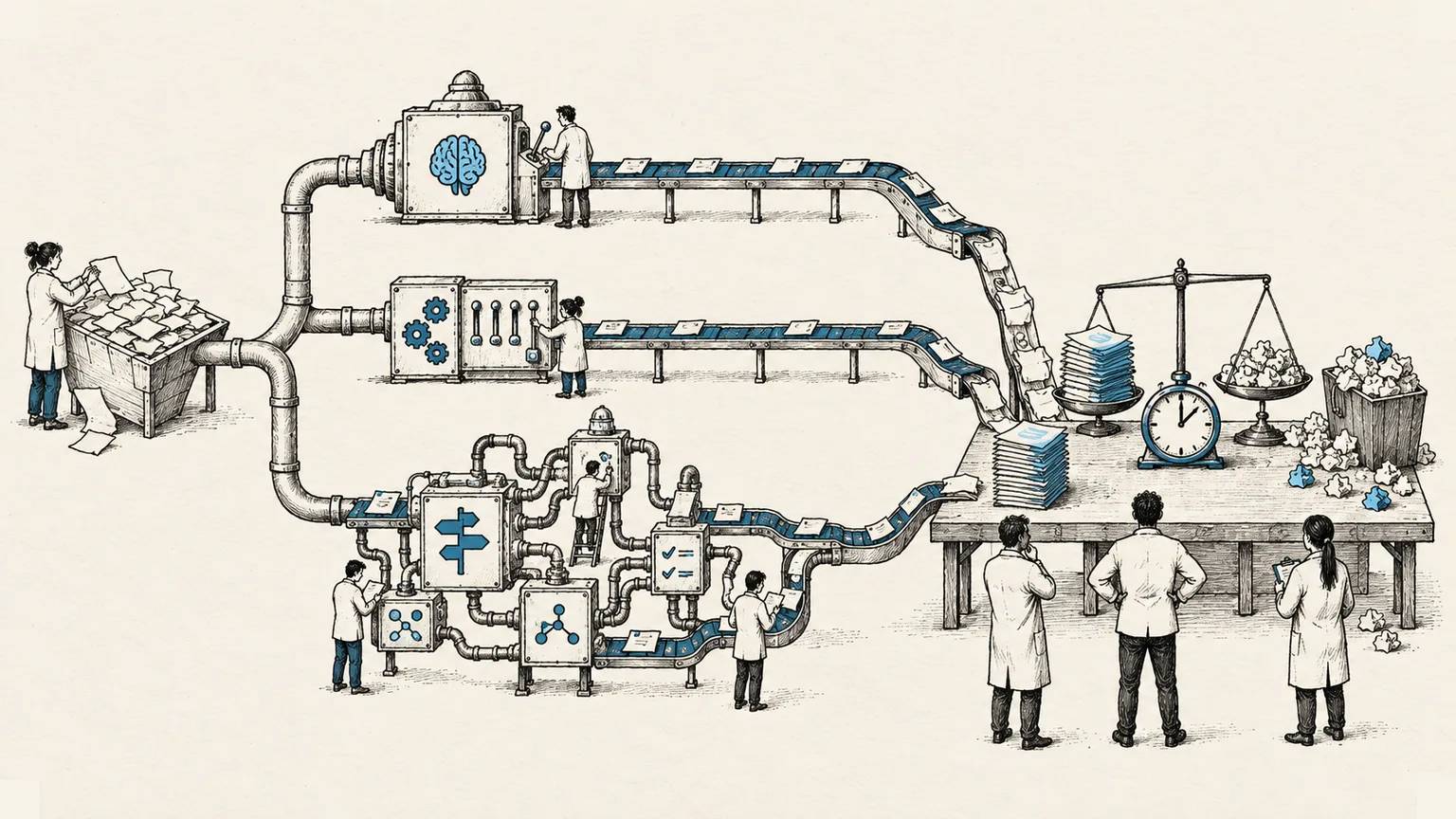
- Why did this request go to that model?
- How often did a difficult request reach the smaller model?
- How often did an easy request go unnecessarily to the expensive model?
- What was the total cost per usable result, including routing?
- How did latency and correction time change after the router was added?
In the article on measuring whether an AI system produces business results, I separated model output from completed work. Routing adds another question to that measurement: when the result is poor, was the model incapable of the task, or did the system send the right job to the wrong model?
The router must earn its place too
You can use several models without needing intelligent routing. Visual documents may go to one model, stable classification work to another, and high-risk decisions directly to the most reliable path. When explicit rules determine the choice, the system is easier to understand and test.
If those rules can reliably assign each request, do not build a router. When the rules stop being enough, you can test predictive routing. But comparing it only with a system that sends every request to the most expensive model would be misleading. Run the same workload through three options: the best single model overall, explicit routing rules, and the router.
A second model needs a reason to enter the system. A new decision system that chooses between those models for every request needs a second reason.
The previous article explains when one AI model is enough.
Further Reading
- RouteLLM: Examines routers trained on human preference data that reduced cost while preserving quality on some benchmarks. The results do not measure live company traffic, employees' error-correction time, or business outcomes.
- LLMRouterBench: Compares more than 400,000 examples from 21 datasets, 33 models, and 10 routing methods. It measures benchmark results rather than a live customer-support system, so it cannot replace a company's own cost and quality evaluation.
You can find the other decisions about models, information, authority, and evaluation in the guide to designing an AI system for your business.
If this article was useful
Linking to it from a relevant page on your website or sharing it on social media genuinely helps it reach more people. Thank you for your support.
Linking and brand guidelines →
A small experiment
Loading personal metrics…