From WordPress to Nuxt: Building an AI-Powered Content Pipeline
Written by Evren BalPublished · 4 min read

It has been a long time since I last published a post here. Behind the scenes, my site was running on an old WordPress installation that I had neglected for a long time. Over time, the friction of keeping this setup updated and maintained eclipsed my desire to write.
But the issue wasn't just technical; I was also questioning the very purpose of my content. The setup guides and configuration tutorials I wrote years ago no longer excited me. More importantly, AI has changed what a static guide needs to contribute in order to be worth maintaining.
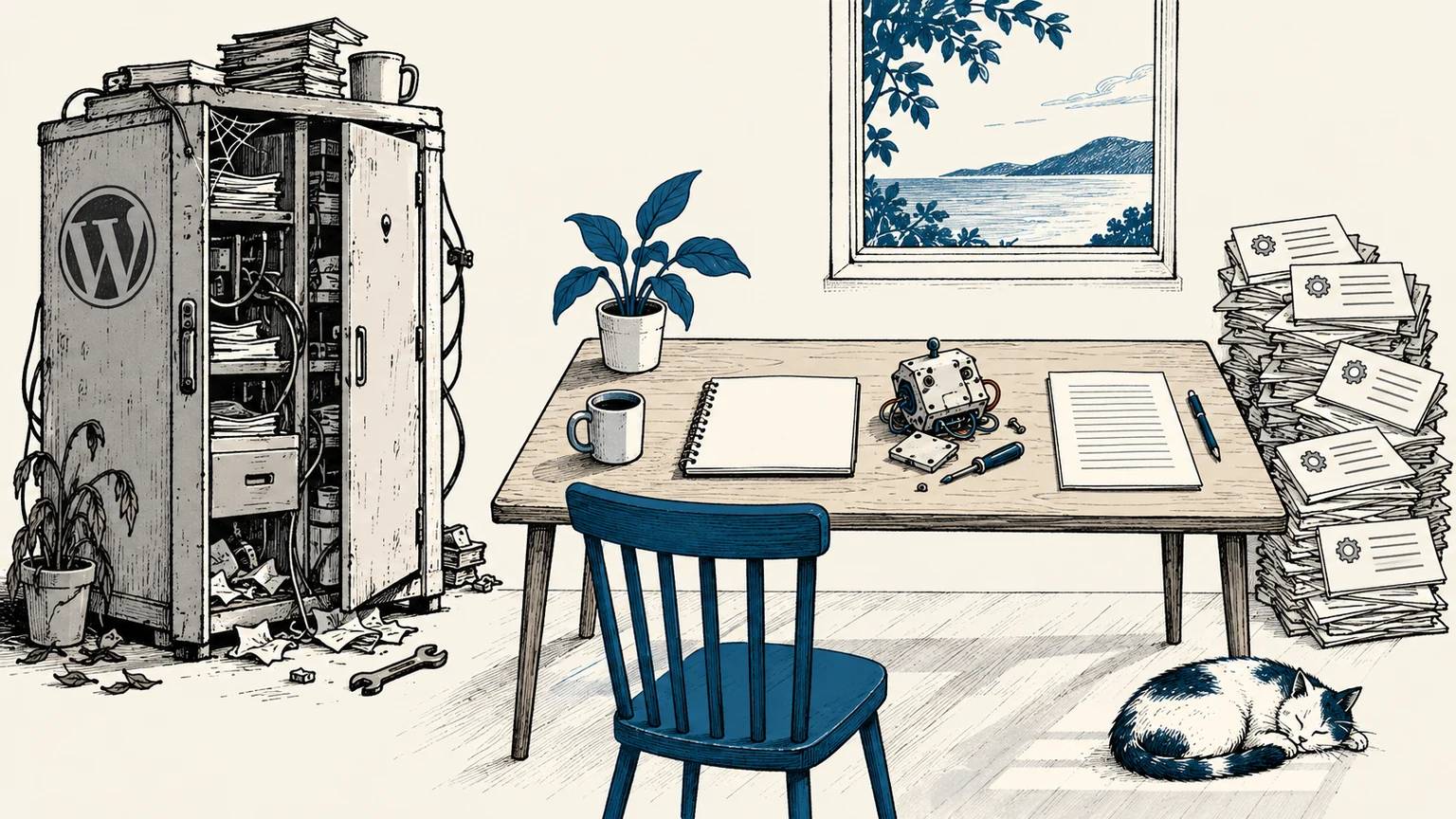
The Demise of "How-To" Guides
Today, if a developer needs to know "how to spin up MongoDB with Docker," they can ask ChatGPT or Claude for a starting point tailored to their environment in seconds. That answer may still be wrong, incomplete, or unsuitable for the reader's version, constraints, or security requirements. It needs verification and context.
That does not make every how-to article worthless. It changes the threshold. A generic sequence of commands that contains no real decision, trade-off, or lived experience is easier to replace and harder to justify maintaining. A guide that explains why a choice was made, what failed, and where the boundary lies can still be useful.
Similarly, I have no interest in chasing tech hype or writing superficial news about the latest model releases and their trillion-parameter counts. In a world where raw information is cheap and immediate, the real value lies in context, strategy, real-world trials, and honest failures.
Going forward, this blog will focus on:
- AI philosophy, business strategy, and its real-world implementation.
- Field notes, architectural decisions, and learnings from my own projects (like Redar, PeşinTaksit, and VaniBot).
- Unfiltered post-mortems of what worked and what didn’t.
A Personal Brandbook and My AI Agents
This transition wasn't just a technical upgrade. Before launching the site, I prepared a detailed personal Brandbook with AI support.
It defines the colour palette, typography, positioning, tone of voice, visual identity, and the practical rules for what to do and avoid. It also includes prompt templates for AI-generated visuals.
I prepared the Brandbook as a shared reference that people can read and AI tools can use. Whether I am working on a blog post or a new software experiment, it gives both a common point of reference.
Additionally, during this migration, I collaborated with AI agents to audit and edit all my past posts, updating obsolete guides and aligning them with my new brand voice. That was the complete review I carried out before this site launched in June 2026.
August 2026 update: I have now carried out a second portfolio review. This one is not a revision of that June work: it is a new pass over which articles still deserve maintenance, which should be refreshed, and which no longer belong in the site. The principle remains the same: keep the work that carries a real observation, decision, or experience; do not preserve material merely because it once existed.

Why a Git-Based Blog, and Why Nuxt?
Historically, I shied away from Git-based static blogging. Locally creating Markdown files, manually formatting them, managing images, and running git commands created too much friction between having an idea and publishing it.
This time, AI is part of the workflow.
By opening my CLI and explaining an idea or raw draft to an AI assistant, I can reduce much of the mechanical work. It can help structure Markdown, flag grammar issues, organise links, and prepare a draft for publication.
I still check the facts, the links, the rendered page, and whether the text says what I mean. The friction is lower; the responsibility remains mine.
For the stack, I went with something lean, fast, and modern:
- Nuxt as the framework, with Nuxt Content for managing posts.
- Cloudflare Pages (free tier) for hosting and instant global delivery.
The result is no database to operate, a simpler publishing surface, fast delivery, and a setup I actually own. It still has dependencies and maintenance work, but those are visible and manageable.
Whether this setup leads to more frequent or more substantial writing remains to be seen. What has changed is the amount of friction between wanting to write and being able to publish.
If this article was useful
Linking to it from a relevant page on your website or sharing it on social media genuinely helps it reach more people. Thank you for your support.
Linking and brand guidelines →
A small experiment
Loading personal metrics…