What is an API Gateway? Should You Use It?
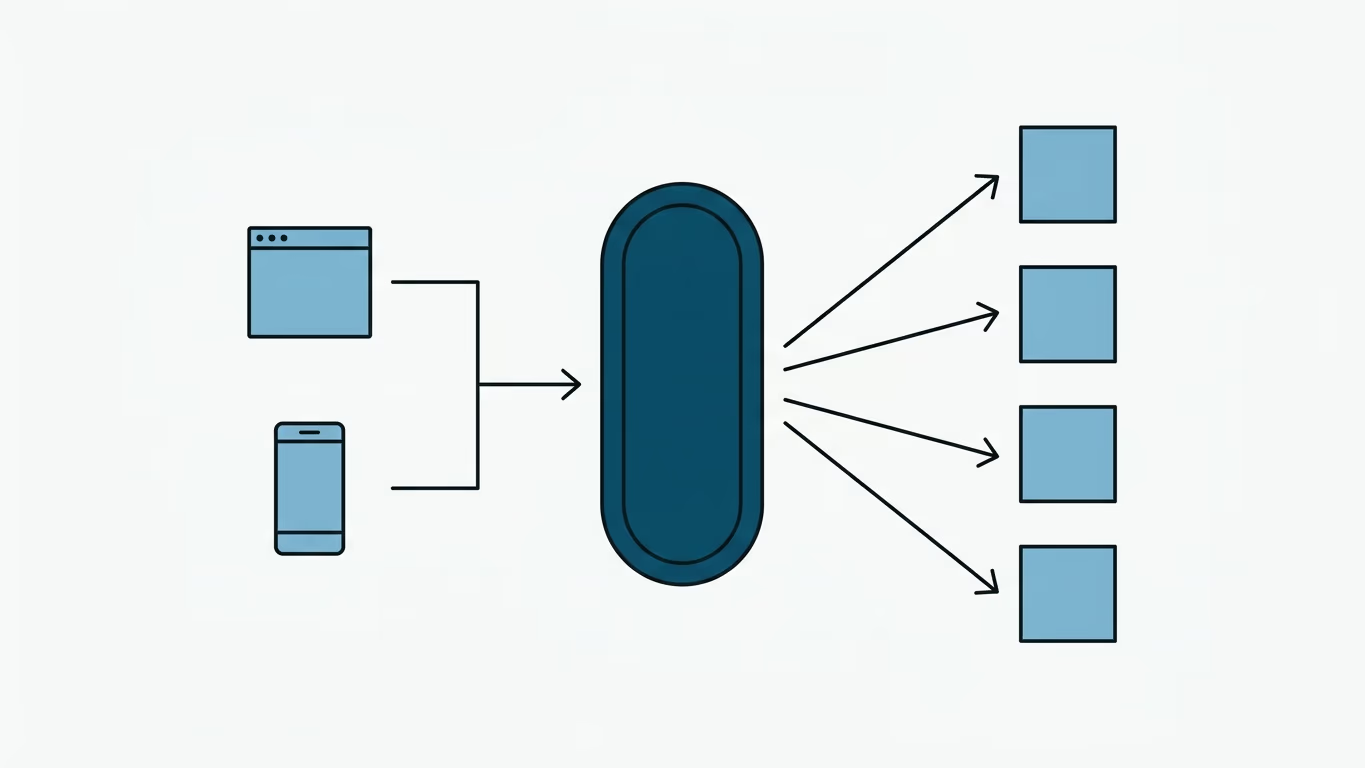
As software architectures transition from monolithic layouts to microservices, having clients talk directly to dozens of individual services becomes an integration and security challenge. This is where an API Gateway acts as a unified entrance.
💡 TL;DR (Quick Summary):
- What is an API Gateway? A management layer that sits between clients (web, mobile, IoT) and backend microservices, serving as a single entry point.
- Key Functions: Request routing, API key/JWT authentication, rate limiting, SSL termination, caching, and load balancing.
- Primary Benefit: Consolidates common security and routing policies in one place, shielding internal microservices from unnecessary overhead.
How an API Gateway Works
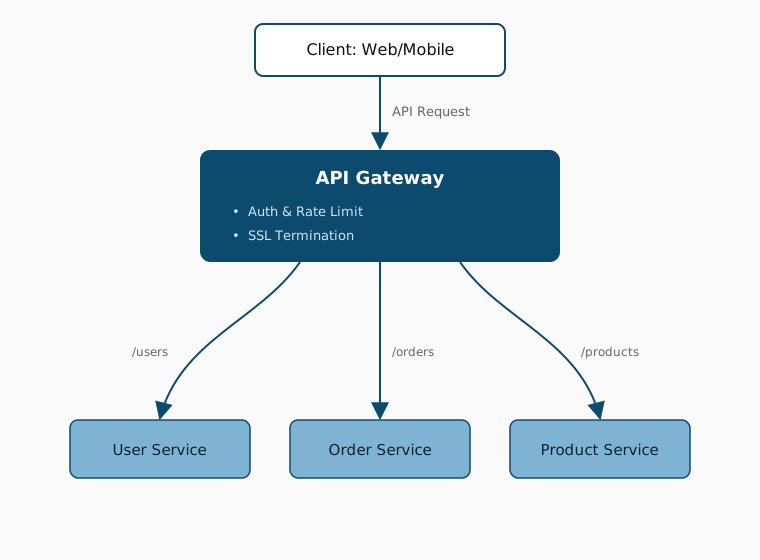
Think of an API Gateway as a smart reverse proxy. Instead of clients figuring out how to connect to various microservices, they send all requests to the gateway, which routes them dynamically:
Why Should I Use an API Gateway?
In a large-scale or microservice-driven environment, an API Gateway provides several key advantages:
- Security & Rate Limiting: Protecting services from DDoS attacks, scraping, or misuse is critical. Instead of coding authentication (OAuth2, JWT) and rate limiting in every microservice individually, the gateway intercepts requests and enforces these rules at the border.
- Protocol Translation: Clients might communicate using standard REST (HTTP/JSON), but the API Gateway can translate and speak to internal microservices via high-performance gRPC or WebSockets.
- Dynamic Routing & Versioning: As your system evolves, you will deprecate API paths or route to different servers (e.g., routing
/v1/to a legacy server and/v2/to a serverless function). The API Gateway handles this transparently without forcing client-side changes. - Caching: Offload database or microservice strain by caching frequently requested, slow-changing responses directly at the gateway.
Popular API Gateway Tools
| Tool | License / Model | Deployment | Key Feature |
|---|---|---|---|
| Kong | Open Source / Enterprise | Self-hosted | Ultra-fast (Lua/Nginx), massive plug-in catalog |
| Apigee (Google Cloud) | Commercial (SaaS) | Cloud-managed | Deep analytics, billing integration, API developer portals |
| AWS API Gateway | Pay-as-you-go | Cloud-native | Seamless integration with AWS Lambda and the AWS ecosystem |
| KrakenD / Ocelot | Open Source | Self-hosted | Excellent support for request aggregation (combining multiple JSONs) |
Frequently Asked Questions (FAQ)
What is the difference between a Reverse Proxy (like Nginx) and an API Gateway?
Nginx is excellent at low-level routing, load balancing, SSL termination, and static file caching. An API Gateway sits a layer above: it understands application logic, processes user authentication tokens, coordinates payment integration, dynamically injects headers, and supports hot-reloading configurations via admin APIs.
Is an API Gateway a Single Point of Failure (SPOF)?
Yes. Because all traffic flows through the gateway, if it goes down, the entire system is unreachable. To prevent this, you must run multiple API Gateway nodes behind a highly available Layer 4 Load Balancer (like Cloudflare, AWS ALB, or keepalived).
Should I use an API Gateway in small monolithic applications?
Usually no. If you only have one backend application server, adding an API Gateway introduces unnecessary architectural complexity, higher management overhead, and minor network latency. Connect clients directly to your web server (with Nginx in front) instead.
Official Resources and Further Reading
- RedHat: What does an API gateway do?
- Kong API Gateway Documentation
- Microsoft: API Gateway design pattern in Microservices
Changelog
- 2026-06-20: Modernized article with visual flows, comparison tables, reverse proxy comparison FAQs, and LLO formatting.