Open Publishing and an AI-Assisted Monthly SEO Reporting Experiment
Written by Evren BalPublished · 10 min read
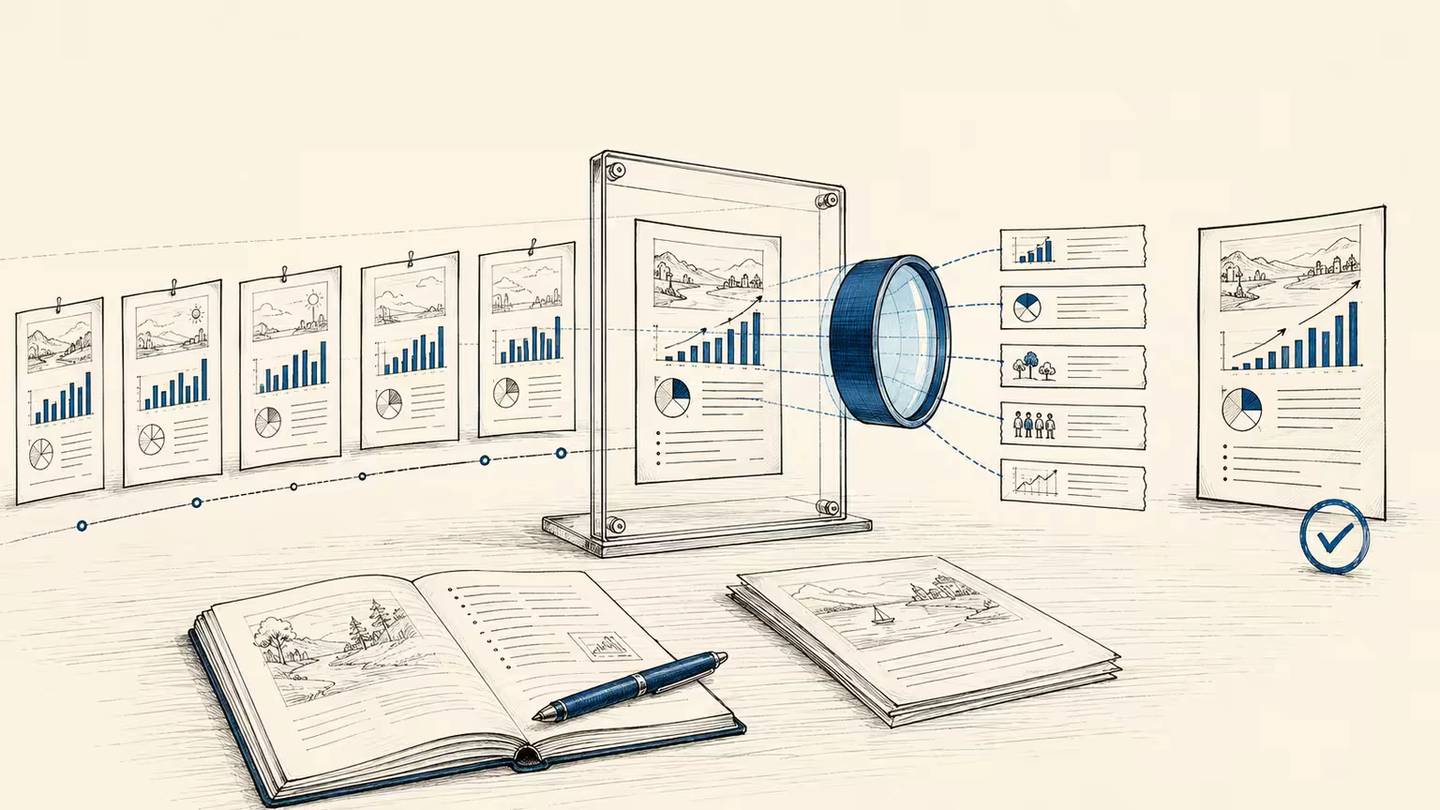
For me, publishing an article means more than handing the finished text to a reader. I also want to keep visible over time why I chose the subject, which assumption shaped the piece, how I measured what happened afterwards, and which questions those results raised. This is the practice I call Open Publishing in this project.
The phrase Open Publishing can refer to different established ideas, including a publishing platform or an Open Access model. I am not claiming either of those meanings here. I use the term in a narrower, personal sense: keeping the publishing decisions, measurement limits, results, and editorial questions that emerge from them visible alongside the articles.
Readers can see the published text. They usually cannot see the choice and assumption behind it, or how I judged the result. That is where much of the real publishing work begins for me.
I do not want to select only the good months and tell their story. Some articles attract more interest than I expected. Others remain quiet. A rising number can look like a positive result until I examine it closely and find that the evidence does not support that conclusion. All of these periods matter if I want to understand how the publication is developing.
Open Publishing does not mean releasing an unlimited amount of data. For me, it means giving readers enough context to assess the result: what I measured, what the measurement cannot show, and which decision I eventually made.
This is not a universal definition of open publishing. It is a working rule I am testing in my own publishing practice.
What I make visible
For every closed month, I publish the number of articles released, visits, unique visitors, and page views. The same page shows the preceding 12-month trend. When search data is available, the report also includes Google Search Console findings and the first date on which new articles appeared in Google results.
I publish a monthly assessment prepared with AI alongside those figures. Readers can see the result and how I interpreted it. The report also makes the use of AI explicit.
But a number and an interpretation are not the same thing.
Why the figures are not enough
The summary cards at the top of a monthly report look straightforward. How many visits were recorded? How many people came to the site? How many pages did they view?
Those figures describe what was measured. On their own, they do not explain why it happened or what I should do next.
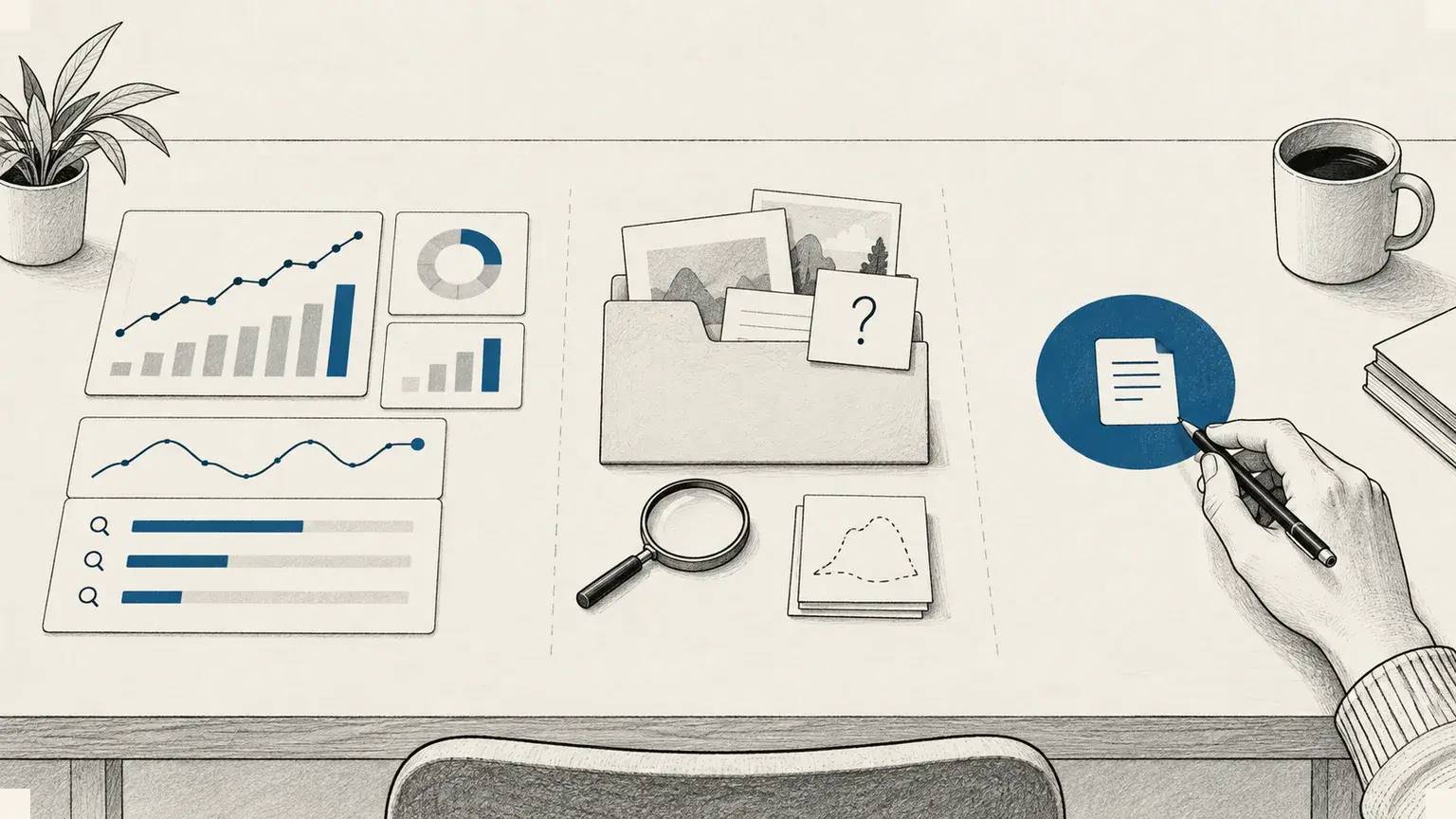
Visitor counts do not tell me how many people became regular readers. Page views do not prove that anyone read an article carefully. The Direct channel in Google Analytics does not always reveal the true source of a visit. When Direct rises, I have a measurement, but not yet an explanation.
That is why I did not design the monthly SEO report as a Search Console export. When search data is unavailable, I evaluate Google Analytics and the publishing inventory. When it is available, I read it alongside organic visits and the pages involved during the same period.
These distinctions are not methodology notes at the edge of the report. They can change the conclusion. They affect whether I treat an increase as success, update an older article, or give a subject more editorial attention.
How I prepare a monthly interpretation
The public report is short. Behind it is a more disciplined process repeated after each completed month.
First, I preserve a raw summary of the month's data. I then prepare a defined set of evidence for the AI to examine. It contains more than the headline totals. Where the data permits, it includes channels, pages, search queries, publication dates, and gaps in coverage.
The AI does not begin by writing the report. It first tests possible explanations. Which channel produced the increase? Was the movement concentrated on one page? Did search visibility and organic visits in Analytics move in the same direction? Has a new article been live long enough to compare fairly with an older one? Is there a simpler explanation?
Not every finding survives this review. The public report does not restate the figures already shown in the summary cards. A comment remains only when historical comparison, contribution analysis, channel separation, or the review of an earlier follow-up question produces something that could affect an editorial decision.
Sometimes no defensible interpretation remains. That is a valid result too. Open Publishing should not create pressure to manufacture an interesting story every month.
AI acts as a second reader
The greatest benefit for me is that the process repeatedly checks relationships across different parts of the data.
The August report produced a useful example. When I placed the first appearances of English and Turkish pages in Google results side by side, a difference emerged. Many of the English pages recorded their first appearance on the publication date or within a few days. Some Turkish pages appeared later, while a significant share had not appeared at all by the data cut-off date.
This raised the possibility that English pages were becoming visible in Google faster than Turkish pages. I could easily have missed the difference during a quick dashboard review focused on total impressions. By reading the publication inventory together with the first-appearance records, the AI put a better follow-up question in front of me.
I do not have a conclusion yet.
The publication date stored on a page does not prove that every language version went live at exactly the same time. Search demand in English and Turkish is not identical. The observation windows for new articles were also short and uneven. Most importantly, the first impression date in Search Console does not tell me precisely when Google discovered or indexed a page. It tells me only that the page had appeared in a search result by that date.
I therefore cannot claim that Google indexes the English pages faster. The hypothesis I can test is narrower: if I verify the publication time for each language and compare equal observation windows, will earlier visibility for the English pages recur in the following months?
That is what I want from a second reader. Not a definitive answer, but a question hidden in the data that deserves testing before I make a decision.
Not every striking number is a success
The same second reading can reject an easy story instead of revealing a new possibility.
In August, page views reached their highest level in the available 12-month history. At first glance, I could have described this as more people reading more articles.
The monthly analysis showed that roughly 85% of the increase came from the Referral channel in Google Analytics. The activity was associated with a single active user. Analytics could not tell me whether this was a reader, automated traffic, or another measurement problem.
I did not present the record as reader growth. The number was accurate. The meaning I could safely assign to it was limited.
Previous reports and 12 months of data serve different purposes
Earlier reports mattered in the first version of the system, but they were not enough. An AI that reads only the previous two monthly reports can remember which questions were raised. It cannot know whether the current month contains the highest value in the last 12 months. Nor can it reliably tell whether a query has appeared for the first time or an older page is behaving unusually against its own history.
I therefore gave the process two different forms of memory.
The first is editorial memory. The AI reads the reports and analyses from the previous four completed reporting periods, then carries over unresolved questions from the latest follow-up log. A topic that mattered last month is not forgotten merely because it fell out of the leading rows this month. The relevant page or channel is checked again.
The second is quantitative history. Each month is evaluated against up to 12 complete, reliable months. This separates a value that is genuinely high from one that is merely higher than last month.
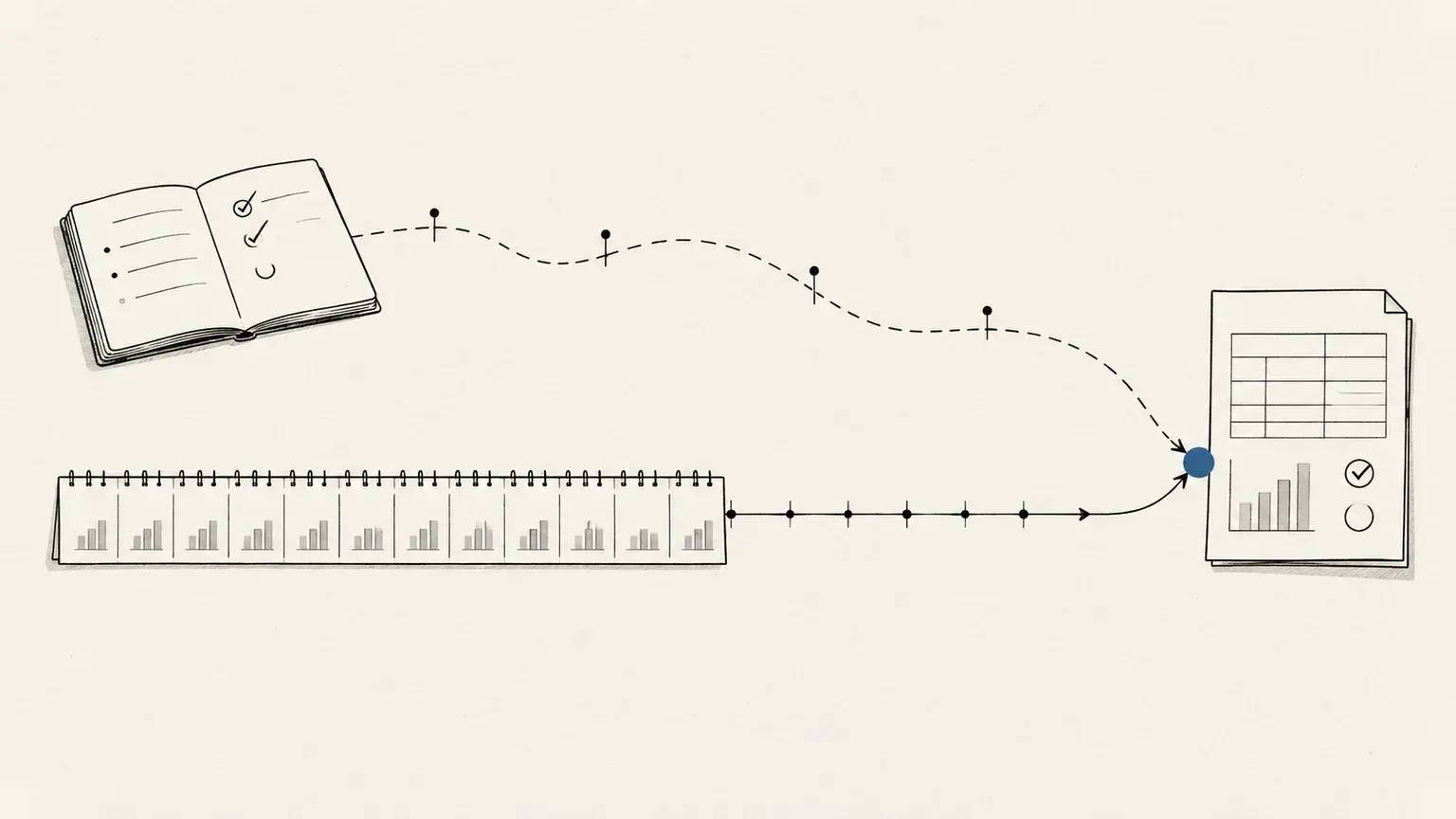
Earlier reports carry the questions. The 12-month data establishes where the number sits.
The distinction may sound small, but comparing July only with June can lead to a different judgment than placing July within a full year. An article performing well for one month has not necessarily set a record against its own history.
A sound analysis can still produce a poor report
The June report exposed another weakness. The analysis was detailed. It respected the measurement limits and resisted an easy growth story. It was also difficult to understand.
The language of analysis had leaked into the language intended for readers. Every intermediate step used to test a finding had made its way into the public report. The conclusion could be correct while forcing readers to learn the analyst's vocabulary before they could understand it.
I did not want to fix only that report by shortening a few sentences. I changed the working rule. The detailed analysis stays in the private record. The public report explains, in everyday language, the conclusion supported by the evidence, the uncertainty that matters, and the implication for a decision.
The process now includes a separate plain-language check. Each sentence should carry one main idea. Figures already visible in the cards are not repeated in the commentary. Analytical detail that does not help the reader understand the decision is removed.
This does not reduce the underlying detail. The detail stays with the evidence. The report's job is to explain clearly what I learned from it.
The responsibility remains mine
I state openly that AI helps prepare the report. That fact is not hidden in a footnote. Readers know how the assessment was produced.
I still define the data boundaries, change the working method, and decide whether to publish the report. The AI does not decide on its own whether a change in traffic qualifies as reader growth. I also remain responsible for the rules that distinguish a follow-up question that has genuinely been resolved from one that simply did not recur that month.
This division of responsibility matters. Fluent sentences do not make an AI-generated draft reliable. Trust comes from being able to see which data was used, which interpretation was rejected, and where uncertainty remains.
For the same reason, I do not publish unrestricted raw visitor data. Openness does not require abandoning privacy or measurement discipline. It means sharing the evidence and limitations readers need to assess the result.
The experiment is still running
I do not regard this as a finished reporting method. Every month can reveal a new weakness.
There may be a gap in a data source. Historical URLs may not match today's publishing inventory cleanly. A newly published article may not have been live long enough to support a decision. The analysis may be sound while the public explanation is unnecessarily complicated.
Each of these problems becomes an input for changing the method. The follow-up log preserves the questions that should move into the next month. A longer historical comparison reduces the risk of exaggerating a one-month movement. The plain-language check reveals poor explanation that might otherwise hide behind analytical accuracy.
There are still questions to test. Will the difference in when English and Turkish pages first appear recur? Can the system remain silent during a quiet month rather than inventing an interpretation? Will unresolved questions lead to better publishing decisions? Can the reports remain detailed while still being clear on a first read?
I do not know the answers yet. That is why I call it an experiment.
I do not see Open Publishing as a dashboard feature. For me, it is a discipline: explain, each month, what I know, what I do not know, and why I made a particular decision. The role of AI is not to speak on my behalf. It is a second reader looking at the same evidence.
A good monthly report does not have to find a positive story. Sometimes the most valuable result is a new hypothesis stated with appropriate caveats. Sometimes it is the ability to look at a record month and say, “I am not calling this growth yet.”
If this article was useful
Linking to it from a relevant page on your website or sharing it on social media genuinely helps it reach more people. Thank you for your support.
Linking and brand guidelines →About this article
- Use of artificial intelligence
- AI-assisted — AI assisted with drafting, adaptation, and language editing. The ideas, process, evidence boundaries, and final publication responsibility belong to Evren Bal.

A small experiment
Loading personal metrics…