Advanced Techniques for Dependency Injection in PHP: Tips, Code Samples, and FAQs
💡 Quick Summary (TL;DR):
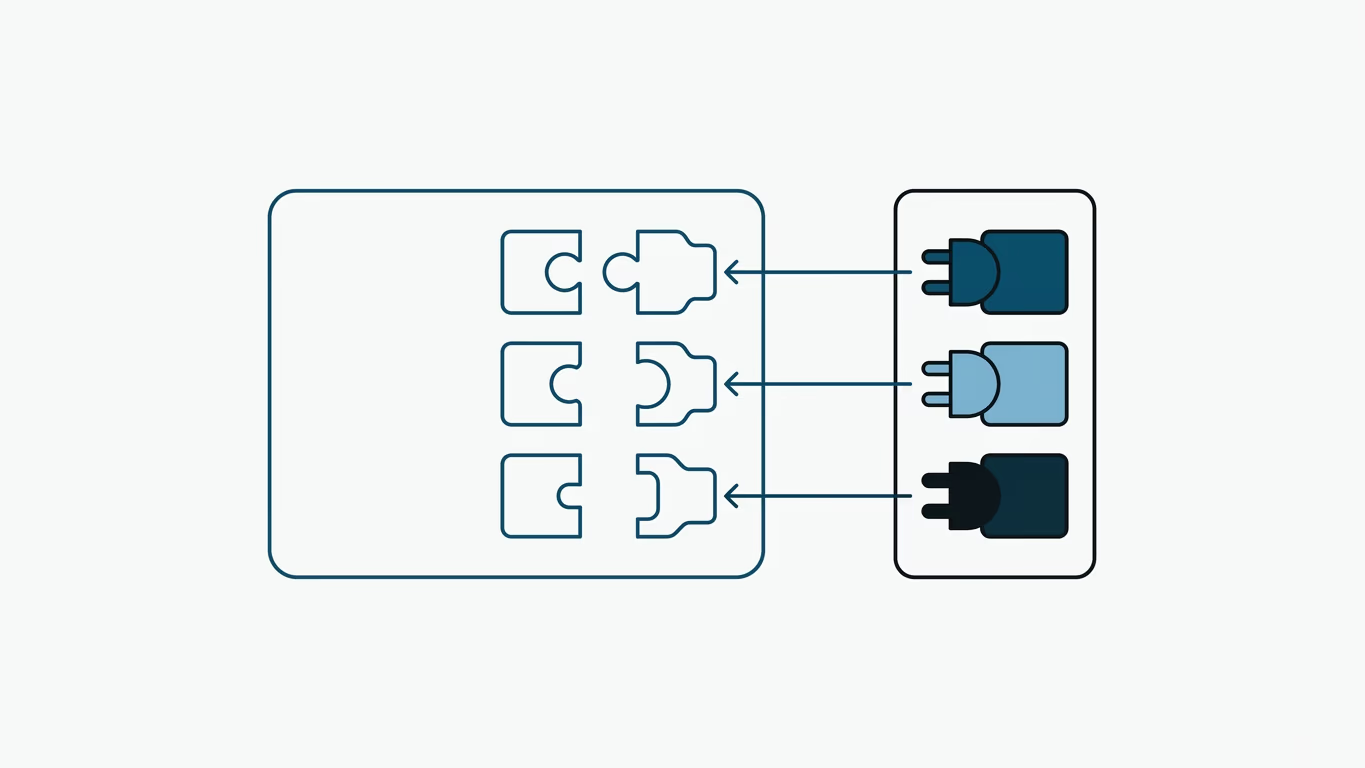
- Core Concept: Dependency Injection (DI) decouples classes from their dependencies, making applications testable and modular.
- Modern PHP (8.0+): Constructor Property Promotion drastically reduces boilerplate code for DI.
- PHP 8 Attributes vs. Annotations: Traditional docblock annotations (like
@Inject) are deprecated; native PHP 8 attributes (like#[Inject]) are the modern standard for auto-wiring configurations.- DI Containers: Service containers (e.g., PHP-DI, Symfony DI) automate the resolution and lifecycle of class dependencies.
Dependency injection is a technique that allows objects to be built in a decoupled manner. It is a powerful tool that can greatly simplify the design of large and complex applications by making code easier to test and maintain. In this article, we will delve deeper into the subject and explore some advanced techniques for using dependency injection in PHP, including code samples to help illustrate the concepts discussed.
One of the key benefits of dependency injection is that it allows objects to be constructed in a manner that is independent of their dependencies. This means that when an object is constructed, its dependencies are passed in as arguments, rather than being constructed within the object itself.
In modern PHP 8.0+, we can use Constructor Property Promotion to define and initialize dependencies in a single line, eliminating boilerplate code:
class Calculator {
    public function __construct(
        private Operations $operations
    ) {}

    public function calculate($x, $y, $operation) {
        return $this->operations->$operation($x, $y);
    }
}
In this example, the Calculator class has a dependency on an Operations class, which is passed in through the constructor. This allows us to easily replace the Operations class with a mock or test double when testing the Calculator class, making it easier to test and maintain.
Using a Dependency Injection Container
An advanced technique for using dependency injection in PHP is to use a dependency injection container. A dependency injection container is a class or library that is responsible for constructing objects and managing their dependencies. For example, we can use a popular library like PHP-DI to configure and resolve dependencies:
use DI\ContainerBuilder;
use Psr\Container\ContainerInterface;

$containerBuilder = new ContainerBuilder();
$containerBuilder->addDefinitions([
    Calculator::class => function (ContainerInterface $c) {
        return new Calculator($c->get(Operations::class));
    }
]);

$container = $containerBuilder->build();
$calculator = $container->get(Calculator::class);
The container is typically configured with a set of rules that define how objects are constructed, and it can be used to construct objects in a consistent and predictable manner. This can greatly simplify the process of building and maintaining large and complex applications.
PHP 8 Attributes for Auto-Wiring
Traditionally, developers used Docblock annotations (e.g. @Inject) to configure property injection. However, in modern PHP development, docblock annotations are deprecated in favor of native PHP 8 Attributes.
Using libraries like PHP-DI 7+, you can use native attributes to define dependencies directly on properties:
use DI\Attribute\Inject;

class Calculator {
    #[Inject]
    private Operations $operations;

    public function calculate($x, $y, $operation) {
        return $this->operations->$operation($x, $y);
    }
}
This helps make the code cleaner, type-safe, and self-documenting, as the dependencies of a class are parsed natively by PHP's reflection engine without relying on slow docblock string parsing.
Dependency Injection Types Comparison
There are three primary types of dependency injection, each with its own trade-offs:
| Type | Injection Mechanism | Pros | Cons |
|---|---|---|---|
| Constructor Injection | Passed via __construct() | Guarantees dependencies are present; supports immutability (readonly). | Harder to manage if a class has too many dependencies (code smell). |
| Setter Injection | Passed via setter methods | Great for optional dependencies; dependencies can be changed later. | Object can be instantiated in an incomplete/invalid state. |
| Property Injection | Injected directly via attributes/annotations | Minimal code; no constructor or setter boilerplates. | Violates encapsulation; hides class dependencies behind magic reflections. |
Frequently Asked Questions about PHP Dependency Injection
How does dependency injection help to improve code quality?
Dependency injection can improve code quality by making code easier to test, since its dependencies can be mocked or replaced with test doubles, and also making the code more flexible, since it can be used with different implementations of its dependencies.
How does a dependency injection container work?
A dependency injection container is a class or library that is responsible for constructing objects and managing their dependencies. The container is typically configured with a set of rules that define how objects are constructed, and it can be used to construct objects in a consistent and predictable manner. It can be used to manage the lifecycle of objects, resolve dependencies, and provide shared instances of objects.
What are the advantages of using attributes for dependency injection?
The advantages of using native PHP 8 attributes include making the code more readable, type-safe, and self-documenting, as the dependencies of a class are clearly defined and native to the language. It also eliminates the need to manually wire dependencies in code or write verbose docblock strings.
What is the difference between Constructor injection and Setter injection?
Constructor injection is a way of injecting dependencies into an object by passing them as arguments to the constructor. The dependencies are defined in the constructor signature. On the other hand, Setter injection is a way of injecting dependencies by calling setter methods on an object after it has been constructed. With setter injection, dependencies are passed in through setter methods, this approach is useful when a class has optional dependencies.
What are some popular PHP Dependency Injection libraries?
Some popular PHP Dependency Injection libraries include PHP-DI, Pimple, Zend Service Manager, and Symfony DependencyInjection component.
How to pick the right Dependency Injection technique?
The choice of Dependency Injection technique depends on various factors such as project requirements, team preference and experience, maintainability and scalability. It's generally recommended to start with Constructor injection and as the project becomes more complex and requirements change, using a Dependency Injection Container library like PHP-DI or using attributes can be considered as advanced techniques.
In conclusion, dependency injection is a powerful technique that can help to simplify the design of large and complex applications. The advanced techniques discussed in this article, such as using a dependency injection container and native PHP 8 attributes, can help to take your use of dependency injection to the next level and make your code more maintainable and testable.