Why Sales and Other Departments Keep Clashing
Written by Evren BalPublished · 17 min read

Because Sales sees today's customer, while other departments see the system that may break tomorrow.
💡 Quick Summary (TL;DR):
- They are accountable for different consequences of the same decision. Sales sees the customer and order in front of them; other teams see margin, capacity, and what happens when the same exception repeats across hundreds of customers.
- A tidy CRM record does not tell you everything that happened in the conversation. “Lost on Price” can hide either a genuine price objection or a shallow sales process the salesperson abandoned too early.
- Manager approval does not remove the cost. If the outcome never returns to the decision process, the company does not learn and the same argument starts all over again.
Sometimes the people working at their desks do a genuinely good job. The technical documentation is complete, the brochure looks sharp, and the message is consistent. You may even have commissioned an AI-powered app that lets painters try your paint colors on screen.
Then the salesperson comes back from a dealer visit.
You ask whether the app was demonstrated. The salesperson tells you that the dealer asked about payment terms and price, then said, “Your competitor is practically camped outside my door.” A dealer doing business worth millions of lira brings up a three-day trip to Taiwan or Amsterdam halfway through the negotiation. The person who will sell your product at the counter wants to know whether there will be gold or a gift card at year-end. The painter skips the technical data sheet and asks his first question:
“Any freebies?”
The world built at a desk and the world the salesperson enters can be that different.

Sales and Marketing may even appear as one department on the organization chart, yet they are often not talking about the same customer. At times, they become genuinely irritated with each other. Marketing thinks Sales is failing to use good material. Sales thinks Marketing has no idea what the customer is actually like.
The Sales-Marketing conflict is simply the most visible version. The same tension appears elsewhere in the company. The team responsible for CRM asks, “Why are you not entering the data?” The people responsible for pricing and profitability ask, “Why did you give another extra discount?” Marketing cannot understand why the campaign material went unused. The salesperson hears all these questions as one more obstacle created at a desk by people who have never met the customer.
There are sound reasons behind those questions. Without CRM data, you cannot forecast sales. If every salesperson discounts at will to close a customer, pricing discipline and profitability fall apart. If the brand is explained differently at every dealer, eventually there is no common language left. Sales, meanwhile, is focused on the customer sitting across the table and the order that is about to walk away.
Head office has to maintain a common corporate standard. That is why brand guidelines, pricing policies, and reporting practices exist. The split begins when the white-collar employees who shape those systems assume their own world represents the whole field. Sales makes the same mistake from the other direction when one exception encountered in the field becomes the truth about the entire company.
The white-collar employee working at a desk draws on best practices, ideal scenarios from textbooks, academic papers, and the strategies of global brands. Trying to adapt those ideas to the company is perfectly reasonable. In the field, however, you meet people, relationships, and negotiations that those ideal scenarios never accounted for.
We think we know the same customer
People who resemble us are easier to understand. If you are a white-collar marketing manager, you can make a reasonable guess about what another white-collar employee will pay attention to. You may not live the exact life of an academic, a bank employee, or a call-center worker. There is still some common ground in education, working patterns, and corporate language.
You can also have an idea of what a plumber is like. You can research, read sales reports, and listen to a few calls. You will learn something about that person. You still will not be speaking from inside their world.
I am not placing white-collar and blue-collar people on a scale of value. The white-collar employee does not know the blue-collar worker's world, and the blue-collar worker does not know the white-collar employee's world. That is the point.
When the product is cologne, closing that distance is easier. The same bottle can sit on the security guard's desk at the entrance of a building and on the CEO's desk on the top floor. A marketing manager may be neither of those people, but their own relationship with cologne makes it possible to imagine both.
That comfort disappears when you start selling commercial refrigeration systems. The salesperson is dealing with someone who works in a world the marketing manager rarely encounters in daily life. You cannot infer what that person wants, what they will object to, or which detail they consider critical from your own experience. A persona is only a starting point here. The real information comes from sales conversations, customer questions, and lost business.
That difference is easily erased in a customer persona prepared at a desk. We arrange needs, objections, and buying criteria under neat headings. The result is an orderly person who compares product features, understands the brand promise, and follows the decision path we designed.
Real customers are not that orderly.
A dealer may run a substantial business and still make a three-day trip part of the negotiation. A painter may care about a free promotional item as much as technical performance. The salesperson behind the counter may like the product and still want to know what they will personally receive if they sell enough of it by year-end.
It is easy to dismiss these behaviors as crude, petty, or lacking vision. Once we remove them, all we have left is a sanitized version of the customer that looks good in a corporate presentation.
When the desk-based team ignores these details, it leaves the salesperson in a difficult position. The salesperson does not visit a dealer and recite the corporate copy. They speak according to the world of the person in front of them. They try to translate the brand promise into price, the product feature into something that makes the painter's job easier, and the campaign into the dealer's commercial calculation.
Then both sides criticize them. Head office thinks the message was delivered incorrectly. The field says head office supplied rules and material that cannot be used in real life.
The field does not always give tidy answers to tidy systems
This split is not limited to campaigns. Someone analyzing CRM data from a desk asks why the salesperson is not entering information. The form is clear: What does the customer need? What stage is the opportunity in? What is the next step?
The salesperson visits the dealer to discuss product needs. The dealer spends most of the meeting describing a getaway around Şile and Ağva with his new girlfriend, who is twenty years younger. What should the salesperson put in the meeting notes?
They cannot write, “Customer need identified.” They cannot say, “Opportunity progressed.” If they write, “Dealer discussed his private life,” nobody knows how that information helps the sales forecast. The reality of the meeting does not fit any of the form's tidy options.
Someone from the technical team visits a painter. They have a beer together. The AI-powered paint selection app never even gets opened. The technical specialist then has no desire to fill in a CRM form just to say, “Look, I really did visit the painter.” From their perspective, the job was done. CRM feels like an extra burden of proof placed on top of it.
From a desk, the visit looks wasted and the campaign looks ignored. Perhaps the visit really was a waste. Or perhaps that beer created enough trust to open the technical data sheet at the next meeting. Without a record, there is no way to tell the difference.
The company needs that data. The field still has to record at least the basic facts of the interaction. In return, the technology team has to make CRM easier to use. A system that forces people to spend several minutes navigating fields written in desk-bound corporate language creates its own resistance to data entry.
If the visit consisted of having a beer with a painter, the user should be able to select “relationship visit” with a few taps on a phone and leave a short note if needed. The note could be recorded by voice and then converted into structured fields. There is no need to manufacture a sales opportunity from every visit. It is enough to record the interaction under its real name.
That also makes outcomes such as “commercial discussion did not take place” or “decision-maker was not reached” visible. They do not count as sales successes, but they describe what happened in the field. If eight of ten meetings with the same dealer remain relationship visits, at least there is now a measurable problem.
The argument over extra discounts works the same way. The person responsible for pricing sees margin disappearing on a screen and pricing discipline eroding. The salesperson sees a customer about to leave after placing a competitor's offer on the table. The discount may be an exception that genuinely saves the order. It may also be the easy route taken by a salesperson who has made a habit of avoiding difficult negotiations.
The person at the desk cannot tell which one it is by looking only at the discount rate. The salesperson cannot decide the company's entire pricing policy out of fear of losing one customer. The conflict is not caused by one side being stupid. It exists because the two sides are responsible for different consequences of the same decision.
Sometimes the field is the CRM screen itself
Dealer networks and physical fieldwork dominate sales of paint, building materials, or industrial generators. The flow is different in medical tourism, insurance, and financial services. A lead arrives through a digital channel, lands in CRM, and a salesperson contacts that person to close the sale. Everyone may be sitting at a desk. The team that brought in the customer and the team that speaks to the customer still do not experience the same reality.
The lead generation team thinks: “We put this much work into bringing in leads. Why does the salesperson not care about this one? Why do I have to put everything in the lead title so they understand its importance at a glance?”
The need to squeeze the entire story into the lead title says a great deal. The person preparing the record assumes the salesperson will not open and read the details. They put the country, request, important note, and anything else that might attract attention into the title. The CRM structure is still there, but the work tries to move forward through a miniature brief written into one field.
The salesperson sees a different screen. “If you bring me 100 leads, 60 or 70 of them are garbage. How am I supposed to deal with all this detail?” That ratio may be less a measured result than the salesperson's judgment about the queue in front of them. It still shapes their behavior.
The salesperson believes they can identify a likely buyer at the beginning of a conversation. When told, “You will explain this to every lead, cover our USPs, and follow up this way,” they see wasted time. If pushed, they fill the required fields merely to satisfy the process. The CRM fills up, but shared knowledge does not.
The lead generation team sees the budget and work that went into acquiring the lead. The salesperson sees the time each lead will consume. One side thinks leads are not being given a fair chance. The other thinks low-probability conversations are taking time away from real buyers.
Both sides then bend the system around their own work. The lead generation team overloads the title with information. The salesperson skims the records or writes notes that make follow-up steps appear complete. Both sides seem to be using CRM, but CRM is actually recording the distrust between them.
Even if CRM takes only a few taps, the salesperson's initial judgment about a lead may remain unchanged. They can lose the customer in their own mind during the first conversation because they do not believe a sale is possible. Once they decide, “This person will never buy,” they stop following up properly. They do not try to understand the customer, provide the level of detail requested, or explain the company's advantages. They send the price and move on.
Then they close the lead with “Lost on Price.” The CRM now has a clean outcome. What it does not show is how hard the salesperson tried to understand the customer, which advantages were explained, or how many real follow-ups took place.
The customer may genuinely have walked away because of price. The sale may also have been lost because the sales process never went beyond sending a quote. The salesperson's first judgment then confirms itself. They see a weak lead, invest little effort, and become even more convinced that the lead was garbage when no sale follows.
This is where the lead generation team's objection begins. From their side, the lead never received a real sales process. Adding another required field will not solve that problem; the salesperson can write “follow-up completed” there as well. To separate lead quality from sales effort, you need to examine what happened in the conversation, how the follow-up progressed, and whether the stated loss reason matches the interaction.
A salesperson must be able to shift gears
The person across from the salesperson will not always be a dealer talking about his private life or a painter asking, “Got any caps?” It may be an idealistic architect, a diligent engineer, or someone evaluating the product in technical detail.
At that point, the salesperson has to shift gears. They may leave a reseller after talking about last night's match and walk into a technical meeting where they need to become a commanding presenter who knows every corporate document, technical data sheet, and product detail. They may not take the brochure out of the bag at every visit. They still need to know what is inside it.
Let me use my own work as an example. If someone is trying to sell me a cybersecurity product, they need to know at least as much as I do and preferably far more. Why would I trust their product if they start fumbling at the most basic question?
It does not have to be a security product. You may be selling HR software or an accounting platform. If you are meeting a CTO and a software team, you know they will ask about integrations. Memorizing a few lines such as, “We have an API and documentation,” does not count as preparation.
Can we receive data in real time through webhooks? Can we track it through an event-based model? If you stare back like a dead fish when I ask those questions, my distrust of the salesperson transfers to the product.
I do not expect a salesperson to know every technical detail alone. If the level of the meeting is clear, I expect them to prepare for the basic questions and bring the right technical person for the deeper ones. Saying honestly, “I need to confirm that and come back to you,” when faced with an obscure question is one thing. Being unprepared for a question you knew was coming is another.
You can complete a reseller visit by talking about last night's match. If you are coming to me, you need to answer without missing a beat when I ask about webhooks.
Knowing the field does not mean lowering the standard. It means understanding which standard the person in front of you expects.
Becoming a manager helps you understand both sides. The work does not end there
As people gain experience and move into management, they begin to see both sides more clearly. You understand why the salesperson asked for that discount, why CRM feels like a chore, and why the corporate material does not come out at every meeting. You also see why Finance has to protect margin, sales operations needs a forecast, Marketing needs brand consistency, and the technical team has to defend the product's limits.
That understanding helps, but it does not produce a solution on its own.
The conflict does not come only from people failing to understand each other. The nature of their jobs forces them to look in different directions. The salesperson sees today's customer and order. Other teams see the result repeated across hundreds of customers, the total cost, and the system that may break tomorrow. Even when everyone does their job well, they can still end up in opposition.
Putting both sides in a meeting room and asking them to listen to each other will not be enough. The company has to bring those different realities into the same decision.
Under what conditions can an extra discount be given, who approves it, and how is the reason recorded? How can CRM carry a messy field conversation without lying about it? If sales material goes unused, is the material poor, the customer wrong for it, or the salesperson unprepared? When does one story from the field become a pattern that deserves attention?
Over time, companies put these situations behind manager approval. That control is necessary. When a manager approves an extra discount, Finance still has to live with the lower margin. When an additional promise to the customer is approved, Operations still has to fit the work into existing capacity. The fact that an authorized person made the decision does not make the team inheriting the work happy.
A manager's signature makes the decision-maker and responsibility visible. The cost still lands in another department's budget, time, or capacity. That department will usually follow the decision. Expecting them to be pleased is unrealistic.
The real management work is seeing where that cost lands while pressing the approval button.
Empathy opens the door to these questions. Answering them requires decision rights, incentives, data, and a feedback system. The system also imposes a cost on both sides. Sales has to record its reasoning, learn the product, and stop presenting every customer request as the company's reality. The desk-based team has to make room in the system for interactions that do not look neat in a report, genuine exceptions, and customer decisions that may not be corporate at all.
The manager's job does not end with suppressing the disagreement and granting approval. The outcome of the decision has to come back to the same table.
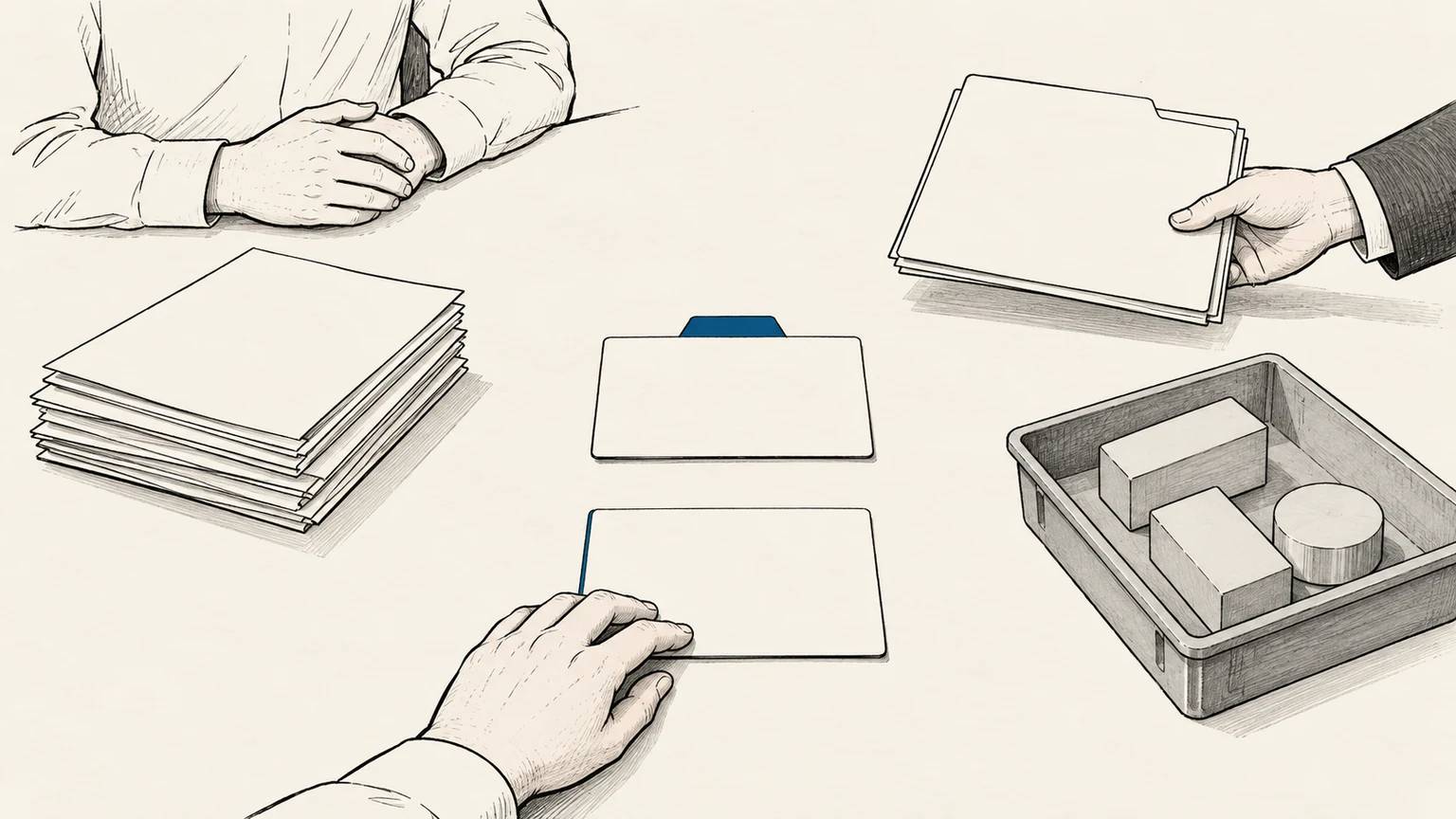
Did the approved discount actually win the sale? Someone has to check. If leads labeled “garbage” convert after proper follow-up, the judgment about lead quality has to change. If “Lost on Price” does not match what happened in the conversation, the report cannot be trusted. Likewise, if sales material that looks excellent at head office never gets used in the field, you need to understand why before blaming the salesperson.
Without that feedback loop, everyone keeps telling their own story. Sales blames a lost deal on a bad lead, a high price, or unusable rules. Other teams explain the same result as a lack of discipline in Sales. The next meeting begins with the same argument.
Experienced managers eventually learn to understand both sides. When that knowledge stays only in a manager's head, the company has not learned. When the reason for the exception, the decision made, and the outcome are kept together, both the rules and the field knowledge can improve over time.
Sales and other departments will not live in the same world. What the company can do is make the cost of one side's decision to the other side visible and carry the outcome into the next decision.
That does not end the conflict. It keeps the same argument from starting over every time.
If this article was useful
Linking to it from a relevant page on your website or sharing it on social media genuinely helps it reach more people. Thank you for your support.
Linking and brand guidelines →
A small experiment
Loading personal metrics…