When AI Changes Work, Training Employees Is Not Enough
Written by Evren BalPublished · 11 min read

💡 Summary: Key Takeaways
- AI usually changes the tasks inside a job before it changes the job itself. The first decision is therefore not which training to buy, but what the new version of the work should be.
- Developing an employee inside the company and retraining someone after job loss are different problems. In the first case, the target job and business context are known. In the second, the employee must move into a new occupation and income structure.
- Training produces results when it is part of a redesigned job. If nobody has defined which decisions the employee will make, which outputs they will check, and which expertise they must retain, general AI training cannot fill the gap.
When a customer service team begins working with artificial intelligence, the first thing to change is usually not the customer service role itself. AI summarises the conversation, drafts an initial response, or helps retrieve the relevant information. The representative still has to decide whether the suggested answer is correct, spot the exception, and take responsibility for the promise made to the customer.
The job has not disappeared. But it is no longer quite the same job.
Companies often respond to this change with training. Employees are introduced to a few tools, briefed on safe use, and expected to become more productive with AI. The missing piece may not be the quality of the training. If employees return from the programme to a job that still exists in its old form, they have nowhere to put what they learned.
People do need to learn how to use AI tools. But the company first needs to design the new version of the work.
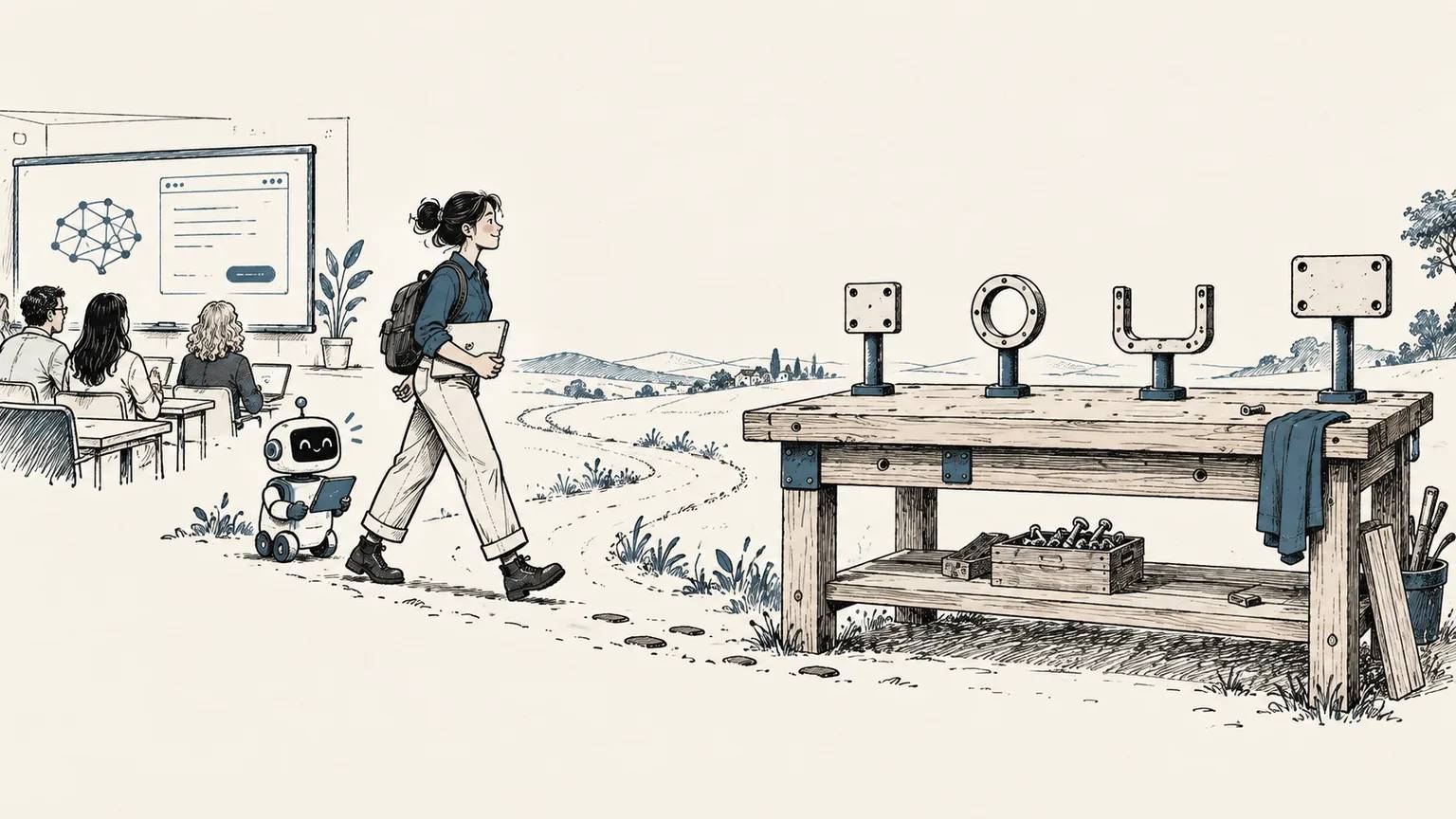
AI exposure is not the same as job loss
An occupation being exposed to AI does not mean that the occupation will disappear. For a company, the practical question is which tasks change and which responsibility remains with the person.
A 2026 World Bank study of AI exposure and complementarity in Türkiye classifies about 41 percent of employment as highly exposed to AI. Reading this as “41 percent of jobs will disappear” would be wrong. The study measures whether AI could technically touch a meaningful share of the tasks inside an occupation. It does not tell us whether the result will be automation, employee augmentation, or a redistribution of tasks.
The OECD's July 2026 Skills in the AI age report makes a similar distinction between exposure and automation risk. Managers, professionals, and engineers are among the groups most exposed to AI progress, while automation risk appears higher in routine, lower-skill tasks. This labour-market view does not hand companies a ready-made training programme. They still have to design which tasks remain with people and which skills employees need to develop.
Because jobs are not indivisible units.
An accountant's work may include collecting data, classifying records, identifying inconsistencies, interpreting regulation, explaining the result to management, and standing behind the final judgement. AI may accelerate some of those tasks, produce only a first draft for others, and make human review more important where the cost of error is high.
Before deciding to “give accountants AI training,” a company needs to see which task is actually changing. If less time goes into gathering records, will more go into review? If the same team can process more transactions, who will manage the exceptions? When the first draft becomes cheap, how will the company preserve the domain expertise required to verify it?
In an earlier article on the difference between using AI and creating value for a company, I argued that model capability is not the same as a lasting business capability. Employee training belongs to the same chain. Knowing how to use a tool may be necessary to perform a redesigned job reliably. It is not sufficient.
One training label hides three different decisions
When we talk about “retraining employees,” we often collapse at least three different situations into one.
In the first, the occupation remains in place while the way its tasks are performed changes. A marketing specialist uses AI for research and first drafts but retains the brand decision and final review. A software developer writes less code by hand and takes on more verification and system-level decisions. The need here is usually to develop new skills within the flow of the existing work.
In the second, the centre of gravity of the role changes. Repetitive tasks shrink while judgement, customer communication, exception management, or quality control becomes the main work. The job title may stay the same, but the value expected from the employee has changed. The role, goals, and authority need to change alongside the training.
In the third, demand for the job genuinely declines. The employee has to move into another role inside the company or into an entirely new occupation. This is no longer about learning to use a tool. The person is entering a new labour market, a different income structure, and perhaps a path to expertise that will take years.
Applying the same AI literacy programme to all three situations does little more than turn the problem into a training activity.
Internal transitions are easier to design
A company developing an employee within their existing field has important advantages. It knows the work, the customer, the data, the cost of error, and the employee's current expertise. The target role is often inside the same organisation.
Skill development may begin in a classroom, but it has to be completed in the work itself. Employees need a working environment in which they see AI output, make decisions, catch errors, and receive feedback.
This skill does not emerge from a one-time tool introduction. Employees need to choose tasks, provide context, test the output, and see mistakes inside real work. The time required for learning should be treated as part of the new operating model, not as spare time around it.
If AI summarises a sales call, for example, training someone merely to produce the summary is pointless. They need to know what happens next. Which signal counts as an opportunity? Which information belongs in the CRM? Who corrects a false inference? Which management decision will use that data?
Training does not answer those questions. The workflow does.
Management's responsibility therefore extends well beyond handing employees a tool:
- separate the tasks AI will take on from those that remain with people;
- make clear who is accountable for the result;
- allocate real working time for learning and control;
- update performance measures to reflect the new version of the job;
- prevent domain knowledge and quality control from disappearing as work accelerates.
When I examined where the capacity released by AI goes inside a company, I argued that we do not need to fill every released minute with more work. That time can also help employees learn the new role, check AI output, and make better decisions. Keeping the old workload intact while adding the new way of working to an employee's spare time merely hides the cost of the transition.
Not every employee needs to become an AI specialist
If AI is changing some jobs, directing employees towards “AI occupations” can look like an easy answer. But the further the new job sits from the employee's current knowledge and skills, the harder the transition becomes.
I see another version of this inside companies. When AI reduces the workload of a valued employee who carries institutional knowledge, management starts trying to invent a new job for them. The reasoning is roughly this: they are already good at job A; even if they have no experience in job B, they have ChatGPT at hand and can use it to get the work done.
Expertise in job A does not automatically transfer to job B. Being able to use ChatGPT gives the employee neither the knowledge of the new field nor the ability to produce reliable work with AI. Someone who does not know which question to ask, where an answer may be incomplete, or how to verify the output can still produce something that looks fluent. That does not mean the work is correct.
Someone who is genuinely skilled with AI tools and agents may be able to move faster in a field outside their expertise. But we should not turn that limited possibility into the general claim that anyone who can use ChatGPT can do unfamiliar work with AI.
Researchers at the New York Fed examined this question using more than 1.6 million workforce development records from 2012 to 2023. Workers from occupations expected to be more exposed to AI saw greater earnings gains after training than similar workers who received only job-search assistance. But when the training prepared them for occupations that used AI more intensively, the result reversed: their earnings gains were 29 percent lower than those of comparable workers who chose more general training.
This does not mean that AI training does not work. It means that moving an employee into a role far from their existing experience simply because the role appears to have a future is not a sound transition plan. Whether the target job actually exists, connects to the employee's current skills, and offers reasonable pay matters more than whether “AI” appears in its name.
A separate World Bank study using LinkedIn data from Türkiye also finds that advanced AI skills are concentrated in a narrow set of occupations and industries. Transitions into those roles tend to come from adjacent technical fields. Demand visible in job postings does not necessarily translate into hiring at the same scale.
The management question is not what extra task can be squeezed into newly available capacity. It is what new value the company can create from the employee's existing expertise. If a new responsibility has no meaningful connection to that domain knowledge, AI does not close the gap. It may only conceal the shortfall behind outputs that look plausible at first glance.
Training should therefore prepare someone for a defined new role—with clear boundaries, accountability, verification, and a business outcome—not for an imaginary “AI employee.”

Managers need to define the new job first
When AI changes tasks, a manager's first move should not be to select a training programme. It should be to define the job the employee will return to after the training.
Defining the new job does not mean adding “uses AI” to the end of an existing task list. It means deciding what output the role will produce, what quality is expected, where artificial intelligence enters the workflow, which decisions remain with people, and who is accountable when something goes wrong. Where AI-created capacity will go is part of that design as well.
The company can then determine the scale of the transition:
- If the role remains largely the same, training can be embedded in the workflow through real examples and control points.
- If the role's centre of gravity changes, authority, accountability, and performance measures must change along with the required skills.
- If demand for the job is declining, the company should identify adjacent roles it genuinely needs and actual openings before it starts training people for them.
- If an employee needs to move into an entirely new occupation, a course is not enough. The transition plan also needs to account for time, potential income loss, and the likelihood of finding work.
Training delivered before these distinctions are made produces an activity that is easy to measure: how many people attended, how many hours they completed, and how many tools they tried. The company should be looking instead at quality in the new role, types of error, decision speed, contribution to business outcomes, and whether the employee remains in the role.
Before approving the training budget, a manager should be able to complete this sentence: “After the training, this employee will be accountable for this business outcome, with this authority and within this control system.” If that sentence cannot be completed, there is no training plan yet. There is only an expectation that the employee will change before the company has defined the new job.
Further Reading
- AI Jobs Transition Framework: A framework for thinking about 2,609 European occupations through automation, work reorganisation, AI-enabled growth, and more limited short-term change. The figures are not unemployment forecasts; they are a provider-authored transition map.
- Anthropic Economic Index, March 2026: Reports higher conversation success rates and harder task selection among Claude users with at least six months of use. This is observational product telemetry, not evidence that a specific training programme will work for all employees.
If this article was useful
Linking to it from a relevant page on your website or sharing it on social media genuinely helps it reach more people. Thank you for your support.
Linking and brand guidelines →About this article
- Use of artificial intelligence
- AI-assisted — This article is based on Evren Bal’s views and assessments. AI-assisted tools were used during the research, translation, and editorial development process.

A small experiment
Loading personal metrics…